
Change used to be an interruption. Now it’s the rhythm of life. The modern world doesn’t simply ask for adapting — it rewards it. Every industry, career, and personal journey is shaped by how swiftly we learn, adjust, and redesign our approaches when the ground shifts. To most people, adapting sounds like a passive act, a survival mechanism triggered when things go wrong. But the truth is, adapting is a conscious strategy, a form of intelligence that anticipates change before it arrives.
Adapting is no longer about survival but strategic evolution. It transforms uncertainty into opportunity by turning flexibility into foresight. In a world where change defines progress, those who adapt consciously shape their futures. Adaptability is the new intelligence, the skill that converts disruption into lasting advantage.
The New Definition of Adapting
In the 20th century, progress followed a predictable path. Education, employment, retirement — a straight line of stability. Today, stability itself is a myth. Artificial intelligence evolves weekly, industries rise and vanish, and even personal values are in constant recalibration. In this reality, adapting is no longer about endurance; it’s about engineering advantage.
The companies that grow are not necessarily the strongest or the largest, but the ones that respond to the smallest signals of change before others do. Likewise, individuals who stay relevant are those who continuously reinterpret themselves — who evolve not because they must, but because they choose to.
The Psychology Behind Adapting
At its core, adapting is emotional flexibility. It’s the mind’s way of rewriting its internal code when external conditions change. Yet, most people resist it because the human brain craves predictability — the comfort of repetition, familiarity, and control. When we’re forced to adapt, our psychological defenses activate, mistaking change for threat.
But the deeper truth is that adapting creates energy. The moment we release the need to preserve the past, mental clarity expands. Instead of protecting what’s gone, we begin shaping what’s next. This is why adapting feels liberating once it begins — it transforms uncertainty into movement.

Adapting in the Workplace
In the corporate landscape, the most valuable skill is no longer technical expertise — it’s adaptability. Job roles mutate faster than education systems can keep up. Five years ago, no one predicted “Prompt Engineer” or “AI Ethics Specialist” would exist. Tomorrow, new titles will emerge again.
To thrive, professionals must adopt what can be called “strategic flexibility.” This isn’t reactive adjusting but proactive adapting — a mindset that keeps learning open, skills fluid, and identity broad enough to absorb disruption without fear. When an employee understands that adapting isn’t about losing their professional identity but expanding it, they stop protecting old versions of themselves and start building new ones.
The future workplace is not fixed; it’s modular. People who adapt fast shape it. Those who wait for clarity get shaped by others.
The Cost of Not Adapting
While adapting fuels growth, resisting it drains momentum. Consider how major companies once ruled their markets and vanished because they mistook dominance for permanence. Kodak invented the digital camera yet ignored it. Blockbuster laughed at streaming. Both fell, not from failure to innovate, but from failure to adapt.
For individuals, the same principle applies. When we cling to past achievements, we stop evolving. Adapting doesn’t erase what we’ve built; it amplifies it. The moment we stop updating our worldview, progress shifts to someone else’s hands.
Emotional Intelligence and Adapting
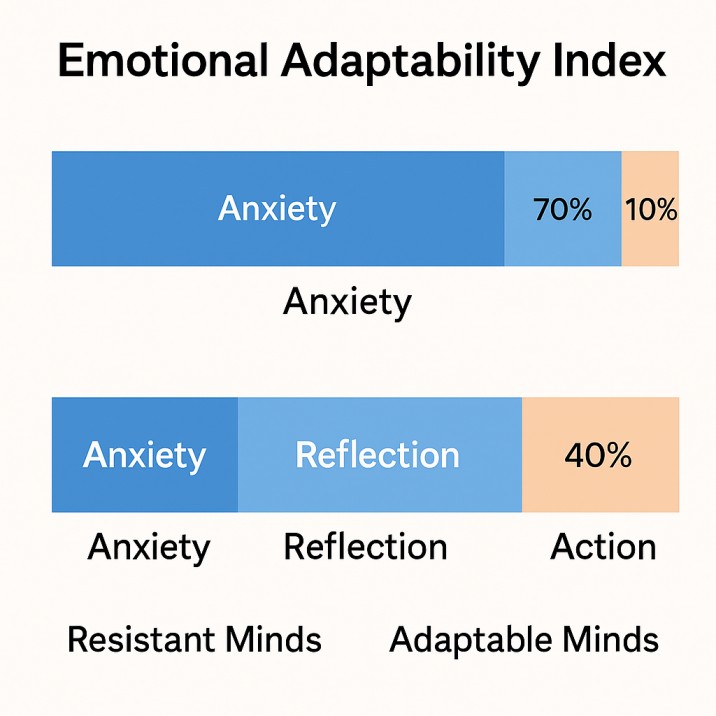
True adaptability is emotional, not intellectual. It requires us to detach from certainty, to observe rather than react. People with high emotional intelligence adapt faster because they manage their inner world while navigating the outer one.
When a setback arrives, instead of labeling it as failure, adaptable individuals see it as data. They analyze emotion, extract insight, and adjust course. Adapting then becomes less about change itself and more about alignment — aligning emotion, logic, and opportunity.
This is why emotional self-awareness is the foundation of adaptability. You cannot adapt to the world if you can’t read yourself first.
Adapting and Creativity
When people think of adapting, they often imagine compromise — giving up, adjusting downward. But in reality, adapting expands creativity. It pushes the brain into problem-solving territory, forcing it to combine old information in new ways.
A musician adjusting to a new genre, a marketer rethinking audience behavior, or an entrepreneur rewriting their business model — all are acts of creative adaptation. The very tension that makes adapting uncomfortable also makes it fertile. Discomfort stretches the imagination.
Innovation isn’t born from stability; it’s born from constraint. When the old ways stop working, creativity fills the gap. Adapting is how creative intelligence breathes — by constantly testing what else might work when nothing seems certain.
The Future Belongs to the Adaptable
In the era of AI and automation, the value of human contribution will rest less on knowledge and more on agility. Machines can store data; only humans can recontextualize it. Adapting will be the new literacy, the ability to reframe skills and insights into new relevance.
Future leaders will not be those who command but those who continually evolve. The power hierarchy will flatten — innovation teams, freelancers, and decentralized thinkers will redefine industries because their nature is fluid. Adaptability will no longer be a “soft skill”; it will be a survival metric for strategic minds.

How Adapting Shapes Identity
Every time we adapt, we reshape who we are. The process may feel like loss at first — shedding habits, roles, or beliefs — but it’s actually identity renewal. Growth is impossible without adaptation because every new version of success demands a new version of us.
Many resist adapting because it feels like self-erasure. Yet, it’s the opposite. Adaptation is integration — taking the best of what was and translating it into what works now. When we adapt consciously, we maintain continuity between past and future without being trapped by either.
There’s a quiet power in people who keep reinventing themselves without losing their essence. They understand that adapting doesn’t mean chasing trends; it means reading patterns. It means transforming challenges into chances for reinvention.
Adapting as a Lifelong Strategy
Adapting is not an event; it’s a lifelong process. The moment we see it as a strategy, not a reaction, our relationship with change evolves. Instead of waiting for crisis, we anticipate shifts, build resilience, and make reinvention a normal rhythm.
The real mastery of adapting lies in foresight — in sensing when the old version of our approach has reached its limits. Those who treat adaptability as a strategy rather than a necessity design their lives around growth instead of protection.
Every pivot we make — personal, professional, or creative — is a signal that we’re alive in motion. Change doesn’t diminish stability; it deepens it by keeping it flexible.
Conclusion
Adapting isn’t survival — it’s strategy. It’s how intelligence expresses itself in an unpredictable world. Those who adapt do more than endure; they evolve deliberately. In the noise of global transformation, the quiet art of adjusting one’s thinking becomes the loudest advantage.
To adapt is to stay awake — to keep sensing, learning, and shaping the unknown into opportunity. The modern world doesn’t belong to the strongest or the fastest, but to those who understand that adapting is the only consistent form of progress left.

Andrea Balint is a writer and researcher focused on human behavior, workplace psychology, and personal growth. Through her work at CareersMomentum, she explores how mindset, leadership, and emotional intelligence shape modern careers. With a background in communication and HR development, she transforms complex ideas into practical insights that help readers build clarity, confidence, and professional purpose.